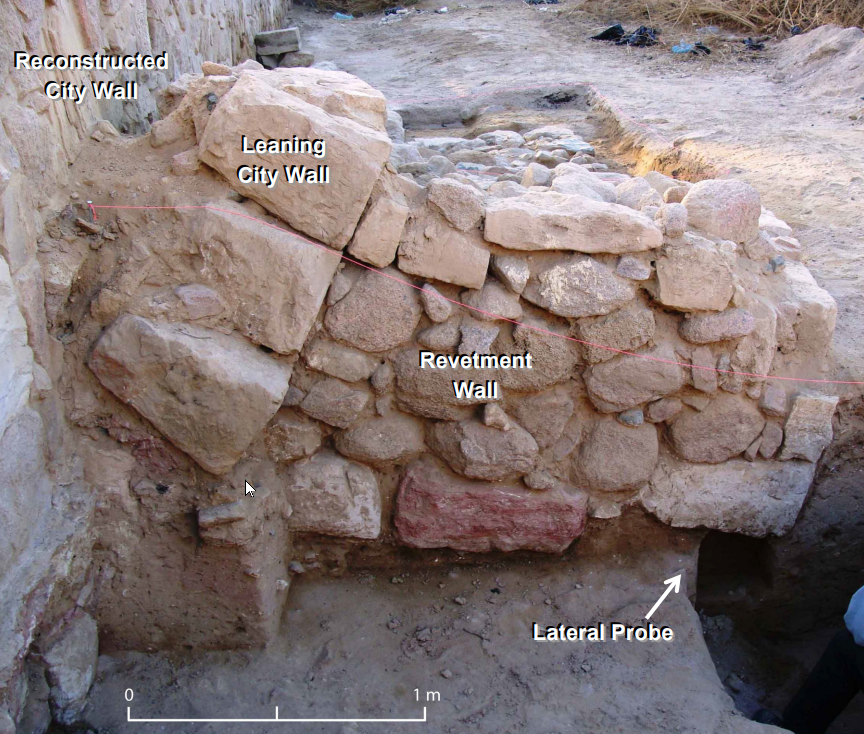
Intermediate Earthquake (?)

Allison (2013:131-132)
interpreted a leaning city sea wall at Early Islamic
Ayla as earthquake damage most likely caused by the
1033 CE earthquake.
In this reading, the original city wall was tilted
during the earthquake, but did not collapse completely,
leaving a damaged wall that required
stabilization. Allison (2013)
speculated that the wall may have tilted due to
liquefaction.
The
revetment wall was therefore interpreted as a
later repair, built against the leaning city wall in
order to support it after the earthquake. Its position
beside the tilted wall suggests that it was not part of
the original city-wall construction, but a response to
damage already visible in the standing architecture
(Allison, 2013:131-132).
Allison favored attribution of the leaning city wall
and its associated revetment repair to the 1033 CE
earthquake because the archaeological dating evidence
places the repair after the
mid-8th century earthquakes but before the final destruction of Ayla in the
earthquake and probable tsunami in
1068 CE. Pottery recovered from inside the
revetment wall was interpreted as consistent with a
repair in the mid-10th century CE or later
(Allison, 2013:124-131).
Radiocarbon evidence also informed this
interpretation. A
charcoal fragment recovered within the revetment
wall yielded a
calibrated date of 777-981 CE
(2σ). Allison therefore
regarded the 1033 CE earthquake as the most plausible
historical candidate, particularly because it falls
within the
Fatimid period, a time when Ayla was still
inhabited and functional enough to justify a major
structural repair
(Allison, 2013:131-132).
This contrasts with the historical earthquake of 1068
CE, which historical accounts describe as catastrophic
for Ayla, with the city effectively destroyed and
nearly all inhabitants killed. In such a scenario,
there would have been little practical capacity or
incentive to undertake a substantial engineering repair
such as the construction of the revetment wall
afterward. Allison also notes that Ayla had already
suffered political and military disruption during the
Fatimid period, including the sack of the city in 1024
CE, but the settlement evidently remained occupied and
economically viable afterward, making a post-1033,
pre-1068 repair scenario archaeologically plausible
(Allison, 2013:74-76,
131-132).
al-Tarazi and Khorjenkov (2007) attributed the tilted wall evidence to the 1068 CE earthquake(s).
the