Mid to Late Holocene Event on the Southern Shutter Ridge

A
Holocene
Event on the Southern Yagur
Shutter Ridge
was identified along the
Yagur Fault, also referred to in
earlier work as part of the
Carmel Fault system. The site lies
on the
Yoqneam-Jalame segment, where
the fault crosses the northeastern margin of
Mount Carmel.
Zilberman et al.
(2007) describe this segment as a several-
hundred-meter-wide
shear zone
marked by shattered rocks, dense fractures,
displaced streams, and tectonically controlled
drainage.
The Yagur Fault forms part of the broader
Carmel tectonic line, a
long-lived boundary between the
Carmel-Israel-Sinai
block to the south and the more densely
faulted
Lower Galilee,
Zevulun Valley,
and
Yizre'el Valley
province to the north. Zilberman et al.
(2007) note that the Carmel tectonic line has
been interpreted by several researchers as a
seismically active branch of the
Dead Sea Transform,
with
left-lateral
strike-slip movement transferring part
of the regional motion toward the
Levant continental margin.
A shutter ridge is a tectonic barrier formed where
fault movement places a ridge across a stream
valley. Zilberman et al. (2007) define such a
ridge as a barrier formed across a stream valley
by
tectonic
activity, blocking downstream flow. The
stream may then divert around the barrier or fill
the impounded space behind it with sediment until
the barrier is overtopped or breached.
At the Southern Shutter Ridge, an eastward-tilted
Turonian
limestone ridge blocked the outlet of a
small stream draining the northeastern slope of
Mount Carmel. Behind this barrier, Zilberman et al.
(2007) documented a thick
back-barrier sequence recording
two main episodes of sediment accumulation. The
older episode began before about 146
ka and continued until roughly
22-27 ka. After a period of
incision,
a younger episode began in the Holocene, when
rapid accumulation of nearly 8 m of
alluvial
and
colluvial
sediment occurred behind the ridge.
Zilberman et al.
(2011) summarized this younger phase as an
almost 8 m thick
Middle Holocene
alluvial-colluvial sequence, older than or equal
to about 5000 years before present, followed by
incision younger than about 2000 years. The
sequence consists mainly of eroded soils and local
carbonate gravels, without the volcanic
components present in the older unit. This shift
in sediment character indicates that the younger
blockage episode was not simply a continuation of
the older
Pleistocene
depositional
system.
The preferred interpretation is that renewed
left-lateral
displacement along the Yagur Fault shifted
the shutter ridge and either partly or completely
blocked the stream outlet. This blockage created a
temporary
sediment trap in a
steep-gradient stream and triggered rapid
deposition behind the barrier. Zilberman et al.
(2007) considered alternative explanations,
including
debris-flow blockage, excessive sedimentation,
or climatic change, but reported that no clear
field evidence for such alternatives was found at
the site.
This Holocene tectonic signal was detected on the Southern
Shutter Ridge but not on the Northern Shutter
Ridge. The Northern Shutter Ridge, located about
2.5 km farther north along the same fault system,
records older left-lateral displacement and a
thick
back-barrier
fill dated mainly between about 200 ka and
100 ka. Zilberman et al. (2011) found no
evidence for young deformation in its sedimentary
fill and concluded that the young colluvial unit
there appears undeformed.
The contrast suggests that the youngest
tectonic signal
was localized, or at least best preserved, on the
Southern Shutter Ridge. Zilberman et al. (2011)
therefore concluded that the Yagur Fault was
active throughout the Late Pleistocene and that
circumstantial evidence
for Holocene activity had so far been found only
at the Southern Shutter Ridge. They cautioned,
however, that much of the Holocene sequence along
the fault trace has been disturbed by human
activity, so evidence for young movement may have
been obliterated elsewhere.
This Mid or Late Holocene Event should therefore be
described as a
geomorphic
and
sedimentological
paleoseismic indicator rather than as a
directly exposed
surface rupture. It records renewed
tectonic activity on the Yagur Fault, probably
expressed by left-lateral displacement of the
Southern Shutter Ridge, temporary stream blockage,
rapid back-barrier sediment accumulation, and
later incision of the young fill.
Dating of the Late Holocene Event on the Southern
Shutter Ridge is indirect and is based on the age
of the
sedimentary sequence that accumulated
behind the tectonically generated barrier rather
than on a faulted horizon or a discrete rupture
surface. The event was inferred from the rapid
accumulation of an approximately 8 m thick
alluvial-colluvial sequence that accumulated after
renewed blockage of the stream outlet by the
shutter ridge.
Zilberman et al.
(2007) report
OSL dates
indicating that accumulation of the younger unit
began after approximately 3.5 ± 0.4 ka and
ended before about 2.3 ± 0.4 ka. Similarly,
Zilberman et al.
(2011) describe the same sequence as a Middle
Holocene deposit older than or equal to about
5000 years before present, with incision of the
modern channel occurring after about 2000 years
before present. Expressed statistically, the interval can
be estimated at both
1σ and
2σ confidence levels. Using the OSL ages reported by
Zilberman et al. (2007), the 1σ range spans
approximately 1500–300 BCE
(3.5–2.3 ka BP). Incorporating the broader
chronological limits suggested by Zilberman et al.
(2011), the 2σ range extends from approximately
3000 BCE to 100 CE (about 5.0–1.9 ka BP).


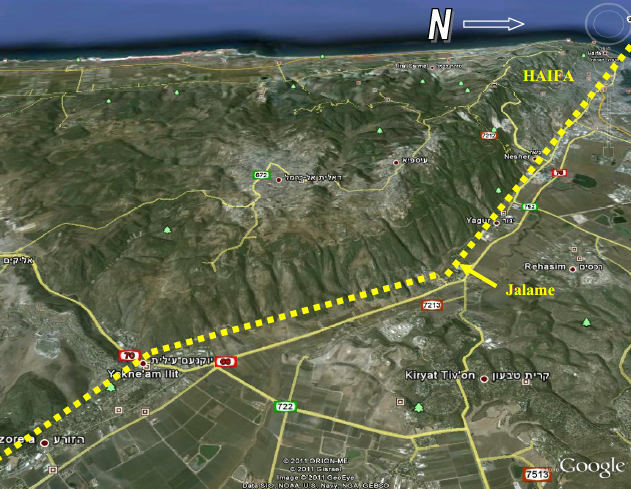


Fig. 15